WOULD YOU BUY IT TWICE?
The Brands That Earn a Permanent Place in Your Wardrobe
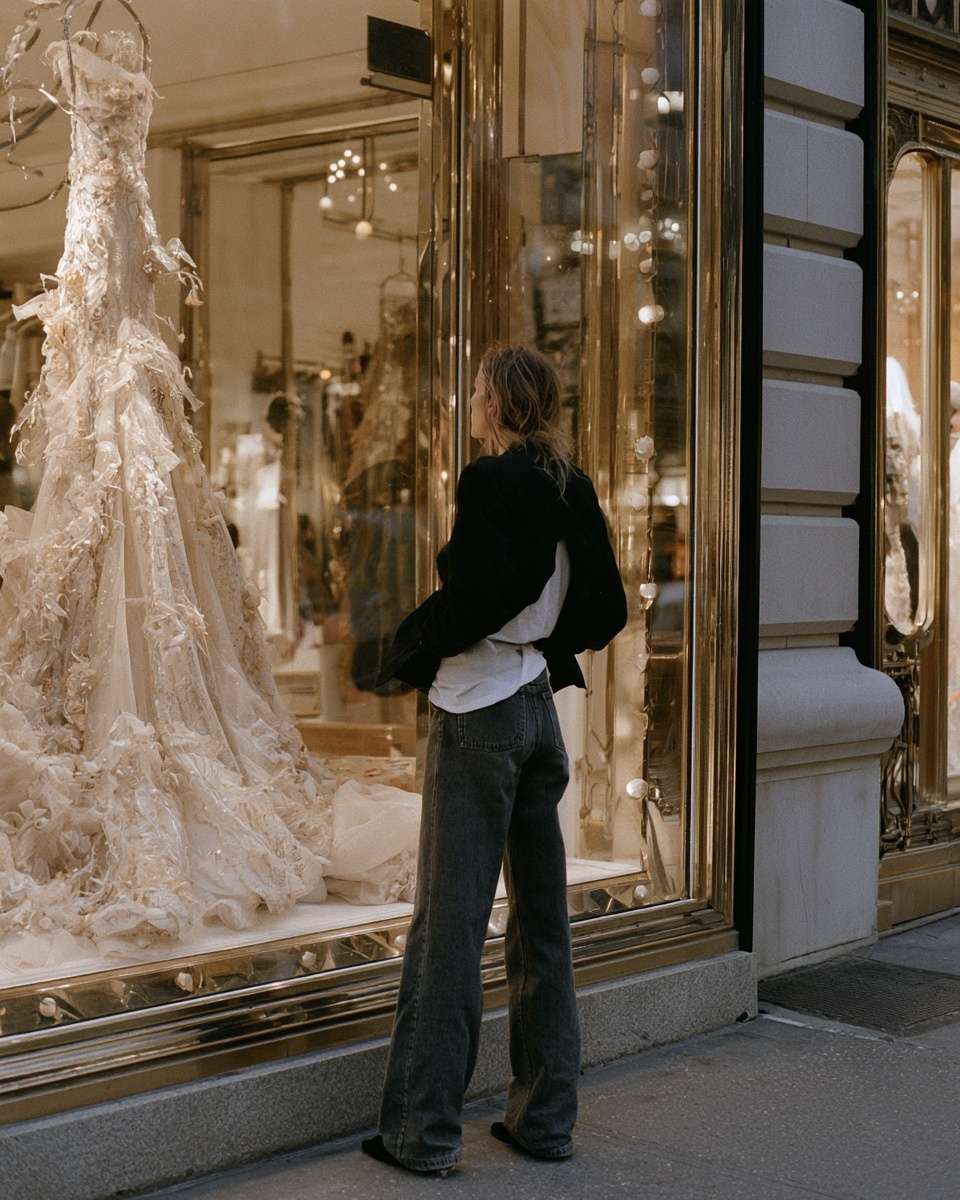
by Valeriia Serebriakova
Fashion has become exceptionally good at making us want something for the first time. A dress appears on a woman whose evening seems just a little more exciting than ours, and for a moment it is surprisingly easy to believe that the right outfit might bring some of that excitement with it.
The real test comes later, when the dress becomes part of our actual lives rather than the ones we imagined.
WOULD YOU BUY IT TWICE?
I do not necessarily mean buying the same dress in another color, although I am considering doing exactly that. I mean returning to the same brand once the novelty of the first purchase is gone. Would you trust the fit enough to order online without trying it on? Would you think of the brand first when another occasion came up? Would the piece prove as convincing in your own wardrobe as it did when you first wanted it?
The fashion industry spends enormous energy turning that first impulse into a purchase. Brands have learned exactly how to find their way into our feeds and, eventually, into our shopping bags. Creating a reason to come back is a different challenge. By then, the campaign is competing with something much more persuasive: our own experience.
My wardrobe makes this distinction embarrassingly clear.
Most of my blazers are from Zara. This is not a particularly romantic attachment to a brand, nor is it a declaration that a mass-market jacket is the pinnacle of fashion. It is much more practical than that. At 5’11”, I often struggle to find blazers with sleeves that are long enough, while Zara’s proportions tend to work for me. After buying enough of them over the years, I know the fit well enough to order online with a fairly good idea of what will arrive.
The strange thing is that I am far more emotionally attracted to other brands. Give me the flowing silhouettes of Rat & Boa or the sculptural, slightly theatrical world of Cult Gaia, and I am much more interested. Wanting something and finding a place for it in your life are not quite the same thing.
I once bought a long black Rat & Boa dress in silk chiffon with white polka dots. It was sheer, sensual, and exactly the sort of thing I am drawn to. I loved the dress more than I had opportunities to wear it, which turned out to be a fairly important distinction.
Cult Gaia gave me an even more perfect version of the same problem. At a sample sale, I found a floor-length silk gown with fluid natural feathers and an almost impossibly good fit. I immediately imagined it for an intimate City Hall ceremony in New York followed by cocktails. It was not a traditional wedding dress, which was precisely the point.
The occasion I had imagined for it eventually disappeared from the calendar, but the gown stayed in my wardrobe for a year before I finally sold it. Yet I remember it more vividly than many of the pieces still hanging in my wardrobe. That matters too.
Perhaps this is where our usual definition of brand loyalty becomes too narrow. We tend to understand loyalty through repetition: a customer likes one product, returns and buys another. Fashion is more complicated because brands can occupy very different places in our lives. Some earn their place through familiarity, becoming the ones we instinctively return to for a certain category. Others stay with us because they gave us something memorable, even after the piece itself is gone. And then there are the brands whose world we love, even if it does not quite fit the life we actually lead.
I was reminded of this just last week, when I took some clothes to Beacon’s Closet, a New York secondhand store, assuming the more expensive labels would be the easiest to resell. Instead, the one thing they bought was a Zara blazer I had worn for years.
The irony was difficult to miss. Zara is not the sort of label around which luxury resale platforms build their businesses, and I certainly would not describe a mass-market blazer as an investment piece. Still, in that store, on that day, someone looked at the inventory and decided that my three-year-old blazer was the thing they could sell.
The original price tag, it turns out, is only one version of what something is worth.
A couple of years ago, I bought a Reformation silk dress at a sample sale for less than $100. The same design is still in Reformation’s collection today, with a regular retail price of $398.¹ Since then, it has become the first dress I think of when I need to dress up. It has worked for everything from a party in Miami to my university graduation in New York. It feels elegant without being too proper and sexy without trying too hard. At this point, I would happily buy its twin in another color.
That may be the purest answer I have to the title of this article.
The funny thing is that Reformation doesn't really have to sell me the second one. The first dress has already done that.
I have even listed it on Pickle, a peer-to-peer fashion rental platform, where it has already attracted rental requests. I bought it at an unusually low sample-sale price, which obviously changes the economics. But it also made me think about how little the number on a price tag can tell us about a purchase in the long run.
At checkout, what we cannot know is the role something will eventually play in our lives. A dress bought for one occasion may unexpectedly work for ten, while the practical choice can spend the next three years decorating a hanger. Something bought at a discount can become the reason we later return at full price.
For the original owner, resale can feel like closure. But for the person buying it, the same transaction can mean something entirely different. Sometimes the second purchase is actually the first. A pre-owned piece may be her first chance to try a brand she has admired from a distance, and to do so at a lower entry point.
And this is not just a theory. The BoF-McKinsey State of Fashion 2026 found that 43% of consumers who first discovered a brand through resale later bought from that brand firsthand.²
Resale value is hardly a perfect measure of quality, and a piece does not need a profitable second life to have been worth buying.
Fashion will always sell fantasy, and I would not want it otherwise. Clothes would be terribly boring if we bought them according to cost-per-wear calculations alone. There should still be room for the feathered gown that makes almost no practical sense and somehow stays with you longer than the pieces you wore every week.
Perhaps the brands we return to are simply the ones that survive the distance between the life they sold us and the life we actually live. And perhaps there should always be a little room in the wardrobe for an occasion that does not exist yet.
Sources
1. Reformation, Anaiis Silk Dress. Current product listing; regular retail price $398.
2. The Business of Fashion and McKinsey & Company, The State of Fashion 2026, BoF-McKinsey State of Fashion 2026 Consumer Survey. The report found that 43% of consumers who first discovered a brand through resale subsequently purchased from that brand firsthand.
Списанието